Corrosion-Resistant Submersible Sensors for Grit and Sludge Tanks
TIME: 2026.11.09AUTHOR: Olina LiNUMBER OF VIEWS 20
If you have ever pulled a "brand-new" level transmitter out of a grit chamber after only four months of service, only to find the stainless-steel housing pitted like a meteor crater, you already understand the problem. Grit and sludge tanks are among the most chemically hostile environments in any municipal or industrial wastewater treatment plant. Standard sensors simply do not survive there. This guide walks you through why these tanks destroy conventional instrumentation, what selection criteria matter, and how to specify a submersible level sensor that actually lasts.
What Makes Grit and Sludge Tanks So Hostile to Level Sensors?
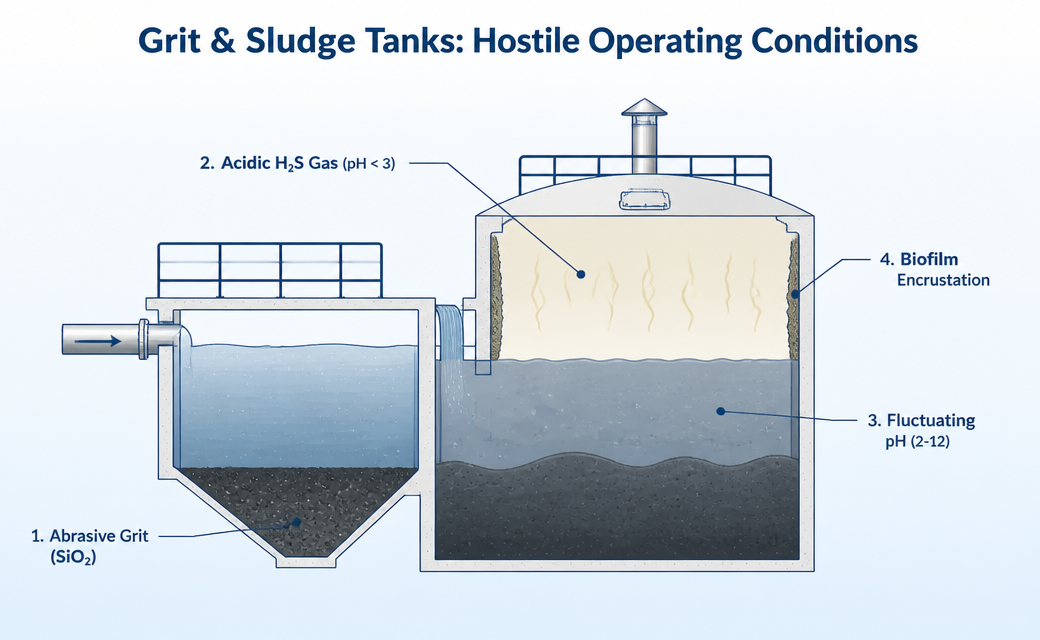
These tanks expose submerged instruments to four simultaneous aggressors that compound each other:
Hydrogen sulfide (H2S) - produced by anaerobic decomposition in sludge blankets, H2S dissolves in condensate to form sulfuric acid (H2SO4), attacking metal housings and cable jackets at pH levels below 3.
Extreme and fluctuating pH - industrial inflows can swing pH from 2 to 12 within a single shift. Even municipal influent routinely drops below 5 during storm events.
Abrasive suspended solids - grit particles (silica, ceramic fragments) with diameters of 0.2-2 mm scour sensor surfaces at velocity, thinning protective coatings and exposing bare metal.
Biofilm and struvite encrustation - microbial colonies calcify on sensor membranes, dampening response and introducing measurement drift that mimics a false high-level reading.
The result: a standard 316L stainless-steel probe in a grit chamber often exhibits measurable signal drift within 6-8 weeks and structural failure within 6-12 months.
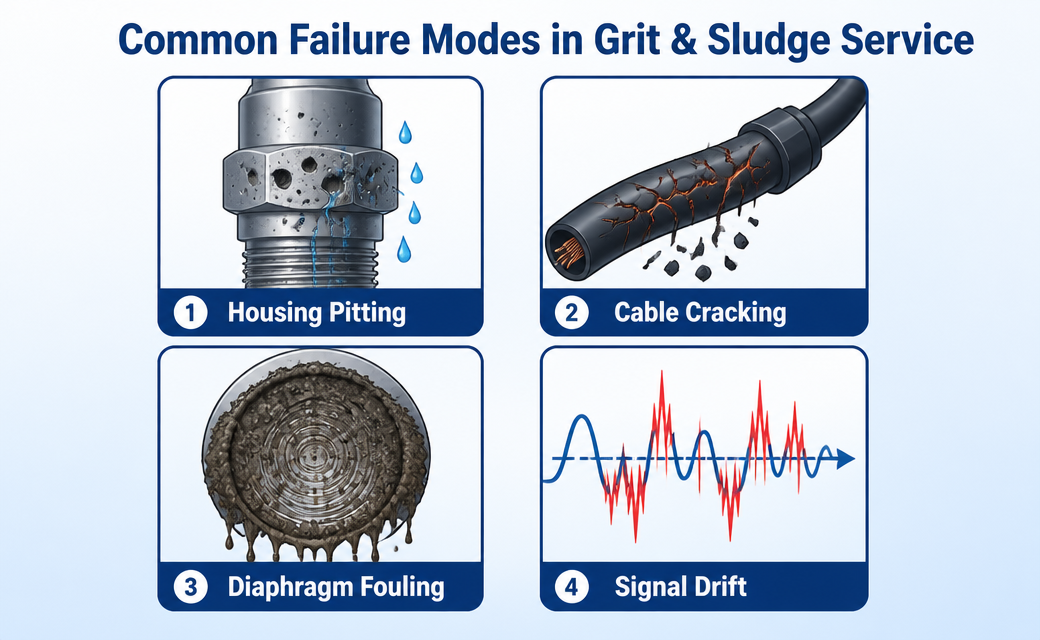
How Corrosion Kills Submersible Sensors: Common Failure Modes
Understanding how a sensor fails tells you what to specify against.
Failure Mode — how submersible sensors fail in grit and sludge service.
Failure Mode
Typical Onset
Root Cause
Visible Evidence
Housing pitting / perforation
3-12 months
Cl- attack on passive oxide layer of 316L
Pinholes in casing, electrolyte ingress
Cable jacket cracking
6-18 months
H2S / UV embrittlement of PVC or cheap PU
Cracked insulation, short circuits
Diaphragm degradation
6-24 months
Acid thinning of metallic diaphragm
Progressive zero-shift, +/-2-5% FS error
Membrane fouling -> drift
4-16 weeks
Biofilm + struvite layer build-up
Signal stuck high; fails to track setpoint changes
EMI-induced noise
Immediate / intermittent
Poor shielding near VFDs, large motors
+/-50-200 uA spikes on 4-20 mA loop
A single failure mode is costly (downtime, re-calibration, safety risk). The combination is why many plants end up replacing sensors two or three times per year on grit and sludge service - consuming maintenance budget and eroding trust in instrumentation.
5 Selection Criteria That Actually Predict Sensor Longevity
Based on field data across hundreds of installations, the following five criteria separate a "buy it again next year" sensor from one that lasts its full design life:
Housing material must be chemically inert, not merely "corrosion-resistant." True inertness (PTFE) means zero measurable mass loss after continuous immersion. "Corrosion-resistant" alloys (316L, Hastelloy) still corrode - just more slowly.
Sensing core with no exposed moving parts or thin metallic diaphragms. Ceramic-based capacitive or piezoresistive elements resist both chemical attack and particulate scour far better than elastomer-backed or thin-foil diaphragms.
Cable jacket rated for the specific chemical exposure. PE handles acids; PU handles abrasion and hydrolysis; PTFE handles everything. Match the jacket to your tank's chemistry.
Certification for your safety zone. Grit chambers and anaerobic digesters can accumulate flammable gas (CH4, H2S). Intrinsic safety and explosion-proof certification (ATEX, IECEx, or China GB) are not optional.
Anti-EMI design and verified long-term stability. Signal integrity near variable-frequency drives demands shielding and galvanic isolation. Drift specs below 0.5% FS/year mean fewer recalibrations over a 5-year maintenance cycle.
Material Decision Guide: PTFE vs PVDF vs 316L vs Titanium
The housing and wetted-path materials determine your sensor's chemical immunity. Here is a practical comparison:
Material — housing and wetted-path materials compared for grit and sludge duty.
Material
Chemical Resistance
Abrasion Resistance
Temperature Limit
Typical Cost
Best For
PTFE (Teflon)
Virtually universal; attacked only by molten alkali metals and elemental fluorine at high T
Good (soft, but self-lubricating)
+260 C
$$$
Strong acids, H2S, mixed organics
PVDF
Excellent for most acids/bases; poor vs. ketones, esters
Fair
+140 C
$$
Moderate chemical duty, cost-sensitive projects
316L SS
Good vs. dilute acids; fails in H2S, high-Cl-, low-pH
Good
+400 C
$
Neutral to mildly alkaline water
Titanium (Gr. 2)
Excellent vs. oxidizing acids and chlorides; vulnerable to reducing acids (HCl)
Very good
+300 C
$$$$
Seawater, high-chloride brines
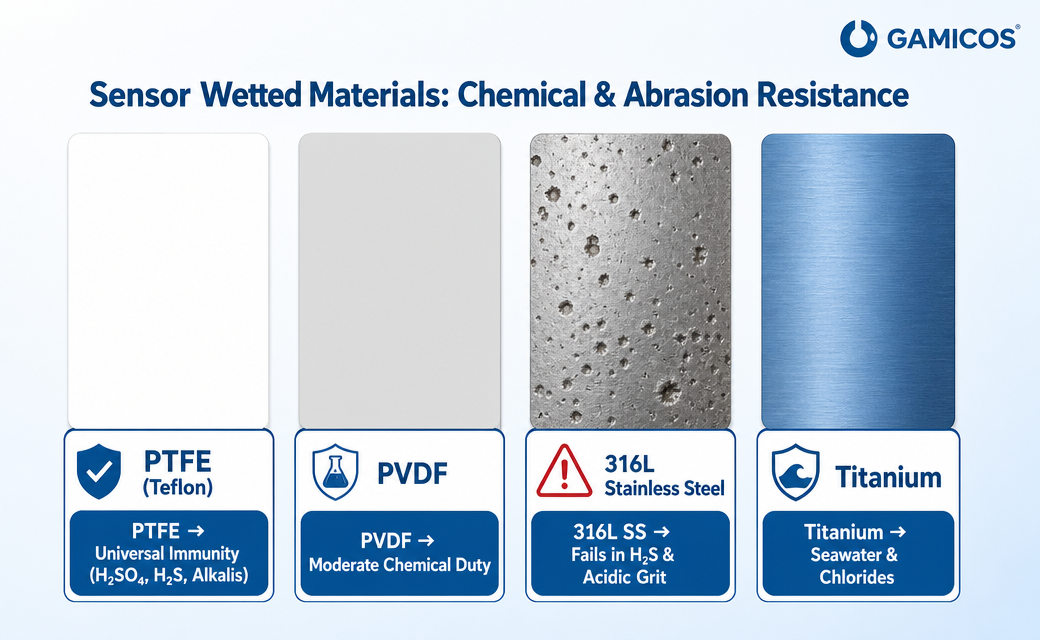
For grit and sludge tanks - where H2S, fluctuating pH, and abrasive grit coexist - PTFE housing with a ceramic sensing element is the configuration that consistently demonstrates multi-year field life. No metallic surface is exposed to the medium, eliminating the corrosion vector entirely.
Image 3 — material comparison — PTFE, PVDF, 316L and titanium coupons after exposure.
Putting It All Together: What a Well-Specified Sensor Looks Like
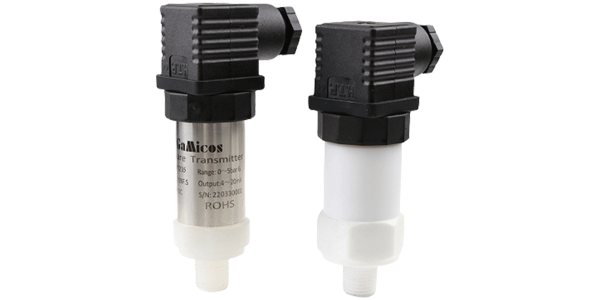
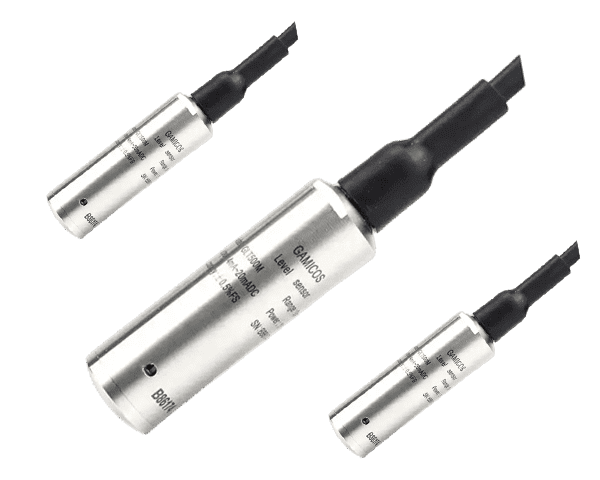
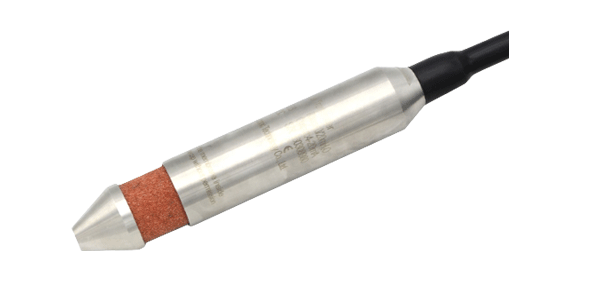
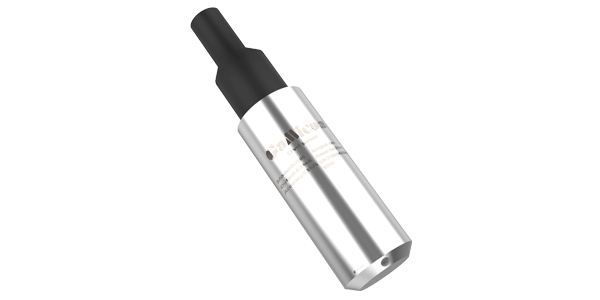
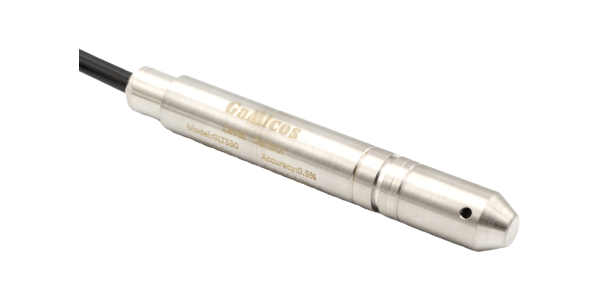
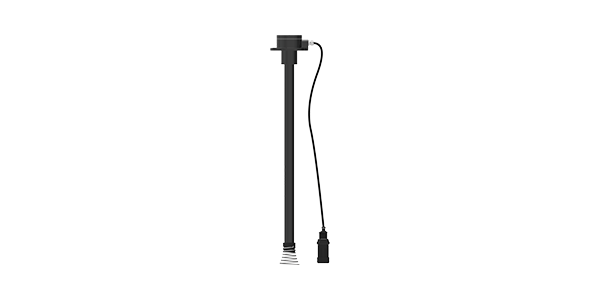
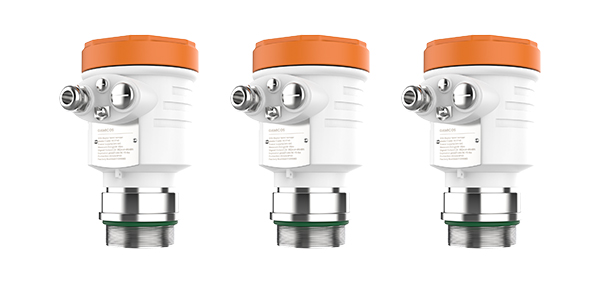
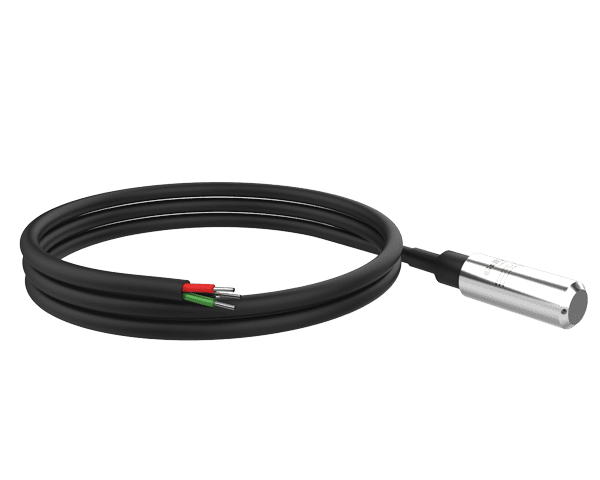
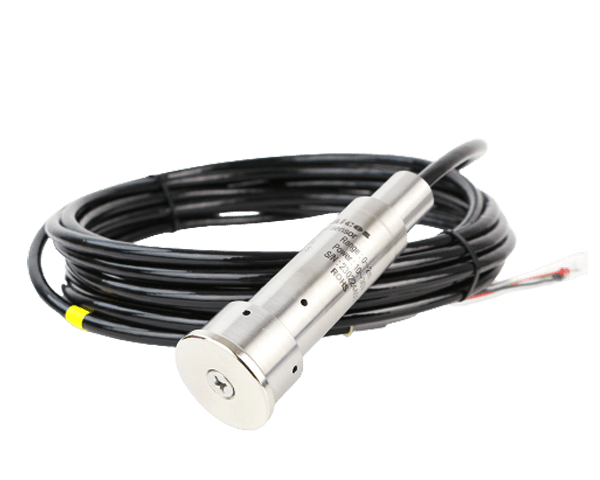
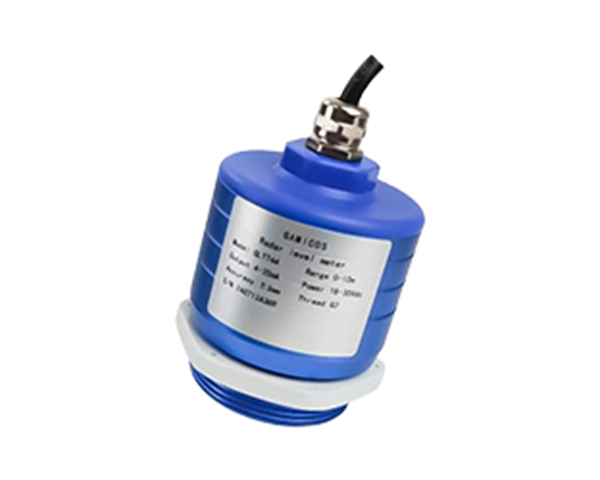
Consider the GaMicos GLT570 anti-corrosive submersible level transmitter - not because it is the only option, but because its spec sheet is a useful illustration of how the five criteria above converge in a production device engineered specifically for this application class.
Here is how its specifications map to real tank requirements:
Stable signal near VFD-driven blowers and agitators
Cable jacket options
PU, PE, or PTFE selectable per tank chemistry
Specify PTFE jacket for worst-case acidic exposure
Burst pressure
300% FS
Safety margin during cleaning cycles or slug loading events
The key insight is not brand preference - it is architecture. A PTFE-clad body over a ceramic sensor element means the corrosive medium never contacts a vulnerable surface. That single design decision eliminates every failure mode listed earlier in this article.
If your plant specifies a submersible level sensor for grit, sludge, or chemical dosing tanks, this combination of PTFE + ceramic is a configuration worth demanding from any vendor.
Frequently Asked Questions
Can I just line a standard 316L sensor with a PTFE sleeve instead of buying a dedicated PTFE-body sensor?
No. The sleeve will be punctured by grit within weeks, and once acid reaches the stainless substrate, pitting progresses rapidly behind the liner where you cannot see it. Dedicated PTFE housings are a single, homogeneous barrier.
What accuracy do I actually need for a sludge tank level measurement?
For pump sequencing and overflow prevention, +/-0.5% FS is typically sufficient. For inventory calculations or regulatory discharge reporting, specify +/-0.25% FS. Beyond that, you are paying for precision your process cannot exploit.
How often should I recalibrate a corrosion-resistant submersible sensor?
A quality unit with <=0.3% FS/year stability drifts below typical process tolerances for 2-3 years. Perform an annual visual inspection and a 2-point field check (zero + known reference). Full bench recalibration every 3-5 years is adequate.
Is explosion-proof certification mandatory in all sludge tanks?
In open, well-ventilated concrete sludge tanks, it may not be enforced. In enclosed digesters, pumping stations with poor ventilation, or tanks receiving industrial influent with volatile organics, intrinsic safety certification becomes non-negotiable. Always check your site's hazardous-area classification.
What is the practical temperature range for PTFE-housed sensors?
PTFE itself withstands up to 260 C, but the limiting factor is typically the electronic assembly and potting compound inside the transmitter. In practice, -40 C to +85 C covers essentially all wastewater applications. If your sludge is thermally treated above 85 C, you need a remote diaphragm seal configuration.
Ceramic vs. piezoresistive ceramic - does the sensing technology matter for corrosion?
Both are ceramic-based and equally corrosion-proof since the medium contacts only PTFE. The practical difference is signal stability across temperature (capacitive has a slightly lower temp coefficient) and resistance to transient overpressure (piezoresistive handles 300% FS bursts well). Choose based on your process dynamics, not corrosion resistance.
Summary
Grit and sludge tanks are the corrosion epicenter of any wastewater treatment plant. H2S-derived sulfuric acid, abrasive grit, biofilm, and pH swings will destroy a standard stainless-steel submersible sensor within one maintenance cycle. The engineering answer is architectural: a PTFE-clad, ceramic-sensing submersible level transmitter - a device where no corrosion-vulnerable material is ever exposed to the process medium.
When you next specify a sensor for these tanks, demand PTFE housing, a ceramic sensing element, verified long-term stability below 0.5% FS/year, proper hazardous-area certification, and the cable jacket that matches your worst-case chemical exposure. The upfront cost premium over a commodity sensor pays for itself in eliminated replacements, fewer shutdowns, and trustworthy data your control system can actually rely on.
If you want to evaluate a specific sensor against your tank conditions, contact the GaMicos team with your tank dimensions, medium composition, and temperature range - their engineering team can confirm the GLT570 configuration (or a custom build) against your actual operating envelope.