






1. Industry Background
New-well acceptance, groundwater surveys, and hydrogeological investigations require confirmation of static water level, drawdown, and recovery level. These measurements directly affect well-depth assessment, pumping-test interpretation, and subsequent pump selection.
Measuring points in these projects are usually dispersed outdoors, with limited space around the wellhead and no guaranteed access to stable power or communication. For periodic inspection and acceptance work, a portable, direct-reading method that can be verified quickly is more economical than building a fixed online system.
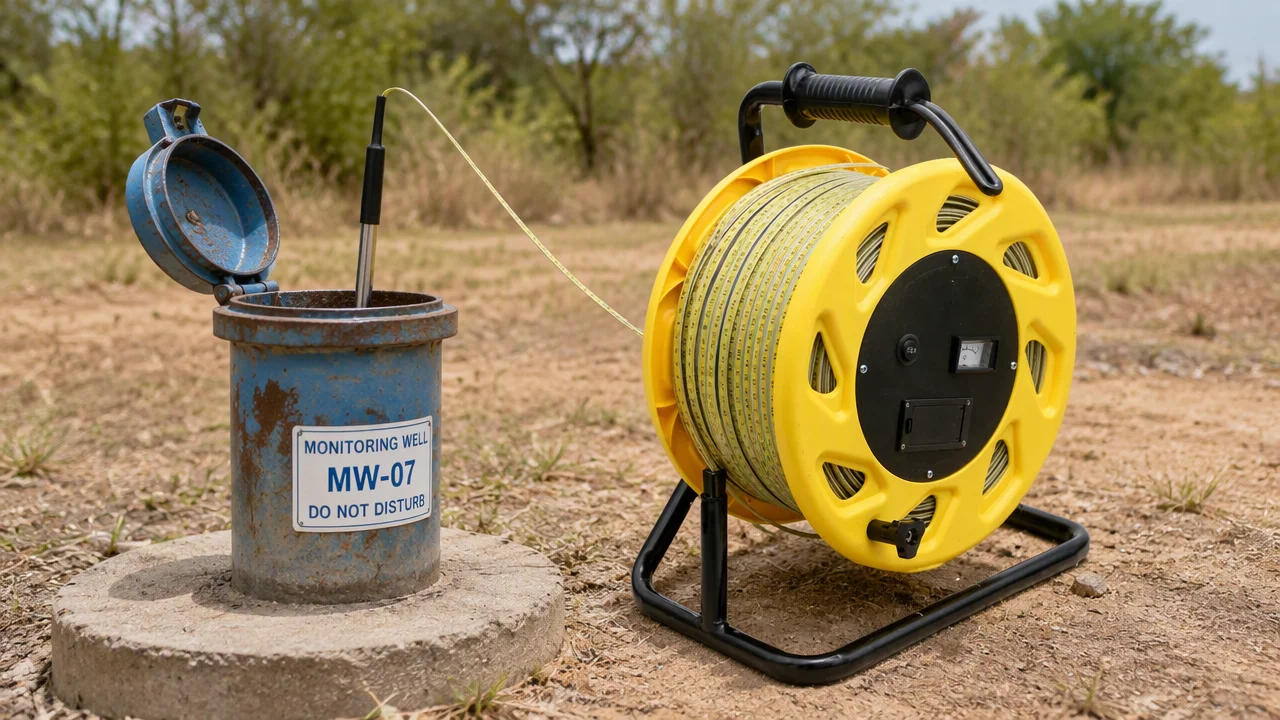
The GLT500A triggers audible and visual indications when the probe contacts the water surface, allowing the operator to read the depth directly from the steel ruler cable. It is suitable for field measurements in deep wells, boreholes, piezometer tubes, and groundwater monitoring wells.
2. Industry Pain Points
Pain Point 1: Deep wells make reliable water-surface detection difficult with an ordinary tape
A deep well has little or no visibility. An ordinary tape provides only a length and cannot confirm whether the probe has actually contacted the water, creating a risk of incorrect readings and acceptance conclusions.
Pain Point 2: Narrow well openings impose strict probe-size limits
Some monitoring wells and piezometer tubes have small internal diameters. A large probe may jam, slowing the work and potentially damaging the cable during repeated lifting.
Pain Point 3: Sites without mains power require extra preparation for wired instruments
Drilling and hydrological sites are widely dispersed. If measurement depends on external power and fixed installation, equipment, wiring, and relocation costs increase.
Pain Point 4: A single indication may be missed in bright or noisy conditions
Depending only on sound or a lamp can lead to missed detection because of drilling noise or strong daylight, requiring repeated measurements.
3. Recommended Product
The GLT500A is a portable steel ruler water level meter for deep wells, boreholes, and monitoring wells. When the probe contacts the water surface, the detection circuit closes and activates both a buzzer and an LED. The operator then reads the steel ruler cable at the wellhead.
- Multiple ranges from 30 to 500 m: Covers shallow wells, production wells, deep boreholes, and dam piezometer tubes, reducing the need for different instruments across projects with a wide depth range.
- 14 mm slim probe: Enters narrow well casings more easily, reducing jamming and repeated lifting where the wellhead and casing space are limited.
- Dual audible and visual indication: The buzzer and LED provide two confirmation channels in noisy or bright sites, reducing the risk of missing water contact.
- Direct reading from the steel ruler cable: Once water contact is indicated, the permanent graduation is read directly without converting a transmitter output, supporting field verification and acceptance sign-off.
- 9 V battery power: Requires no mains supply or fixed wiring and is suitable for mobile work and inspection of multiple wells.
Key Selection Information
| Item | Configuration / Description |
|---|---|
| Measurement ranges | 30 / 50 / 100 / 200 / 300 / 400 / 500 m |
| Probe detection error | ≤ ±0.5 mm |
| Probe | Stainless steel, 14 mm diameter, IP68 |
| Indication | Buzzer and LED |
| Response time | ≤ 1 ms |
| Power supply | 9 V lithium battery |
4. Customer Application Case
4.1 Project Background
An overseas hydrological engineering contractor needed to perform delivery acceptance on newly drilled monitoring wells and record static and recovery water levels before and after pumping tests. The well points were dispersed, some casings had small internal diameters, and the previously used measuring line could not reliably indicate water contact. The following anonymized typical project scenario illustrates the solution configuration and does not refer to a specific customer.
4.2 Solution
Installation location: No fixed installation is required. Lower the 14 mm probe slowly through the monitoring-well opening.
Product selection: GLT500A; select a 100 m, 200 m, or longer steel ruler cable version according to the well depth.
Monitoring objective: Record the vertical distance from the wellhead to the water surface and repeat the measurement at different stages of the pumping test.
Operating procedure: Check the battery and indication functions
Operating procedure: Check the battery and indication functions → lower the probe slowly → read the cable graduation at the wellhead when the audible and visual indicators activate → repeat the reading for confirmation → retrieve and clean the probe.
4.3 Application Results and Acceptance Value
- 30–500 m coverage One product series covers periodic measurement requirements from shallow wells to ultra-deep boreholes.
- 14 mm accessibility The slim probe fits narrow well casings and reduces jamming caused by probe size.
- Dual-channel confirmation The buzzer and LED improve recognition in noisy or bright field conditions.
- No fixed wiring Portable battery power allows rapid movement between multiple well points.
| Acceptance Dimension | Before Application | After Application |
|---|---|---|
| Measurement method | Experience-based or dispersed readings | A standardized measurement process matched to the product positioning |
| Data acquisition | Dependent on temporary operations | Repeatable results obtained at defined points or through defined procedures |
| Maintenance management | Action taken after a problem occurs | Inspection, recording, and abnormal-response actions included in routine management |
5. Solution Summary
The value of the GLT500A is not to replace continuous online monitoring, but to provide a low-preparation-cost, direct-reading, and easily verifiable field tool for borehole acceptance, pumping tests, and periodic groundwater inspections. Projects requiring 24/7 continuous upload and alarms should use a submersible or wireless level monitoring solution instead.
Technical basis: GAMICOS GLT500A official product page—measurement range, probe size, audible and visual indication, power supply, and applicable scenarios.