Hydrostatic vs. Ultrasonic vs. Radar – When Is a Submersible Sensor the Only Choice?
TIME: 2026.10.26AUTHOR: OlinaNUMBER OF VIEWS 35
Three level technologies, three different ways to fail. Here is the short version of which one survives your tank.
Technology comparison · GAMICOS
Choosing the wrong liquid level sensor does not just cost money at the purchase order. It shows up later as a control loop that hunts, a reading that drifts under steam, or an alarm that fires every time the surface foams.
Radar and ultrasonic dominate open-tank applications, and for good reason. But there is a specific set of conditions where a submersible level sensor is not merely an option — it is the only technology that will hold its reading for years.
This guide breaks down how all three technologies actually measure level, where each one breaks down, and how to tell in under a minute which one your application needs.
The short answer
Which technology wins for which condition.
Your condition
Technology
Why
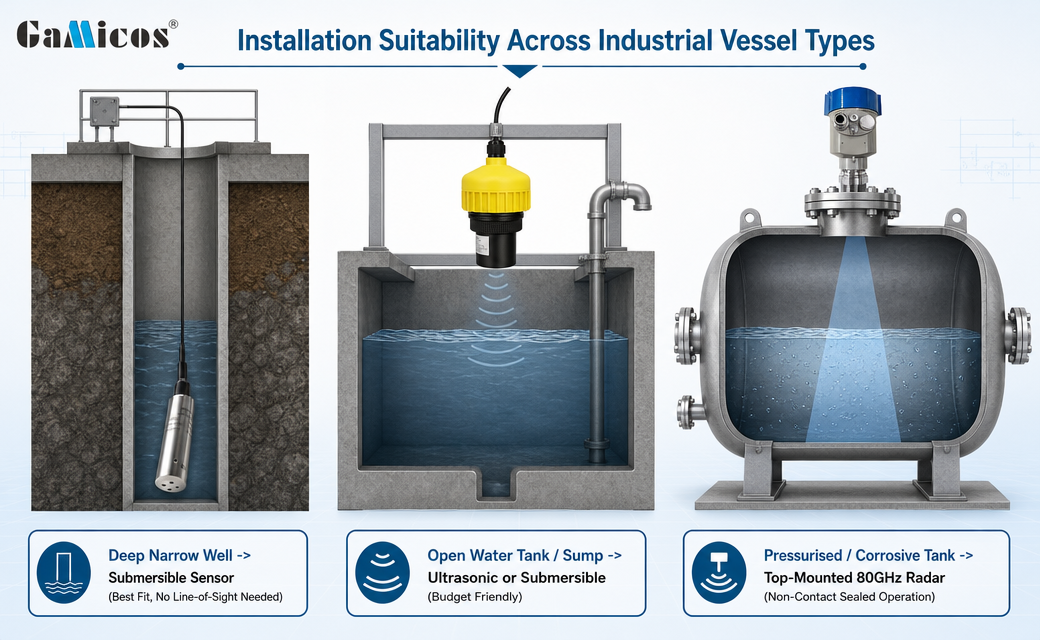
Deep narrow wells, foam, steam, slurry
Submersible (hydrostatic)
Measures pressure at the bottom — the surface can do whatever it likes
Pressurised tanks, >30 m range, sanitary media
Radar
Non-contact, unaffected by vapour or pressure, millimetre accuracy
Clean water, under 5 m, tight budget
Ultrasonic
Cheapest non-contact option in benign conditions
One rule of thumb covers most cases: if the surface is disturbed, is closed off, or is too small to aim at, go contact. If the medium must not touch the sensor, go radar. Ultrasonic sits in the middle — cheapest non-contact option, but the first to fail when temperature, foam or draughts enter the picture.
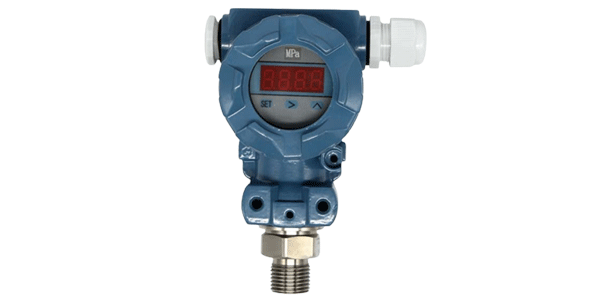
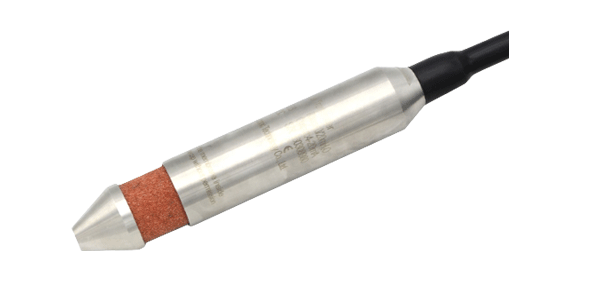
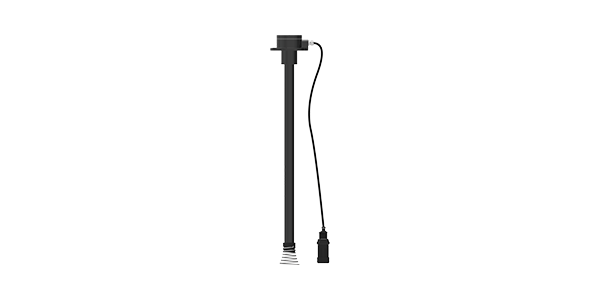
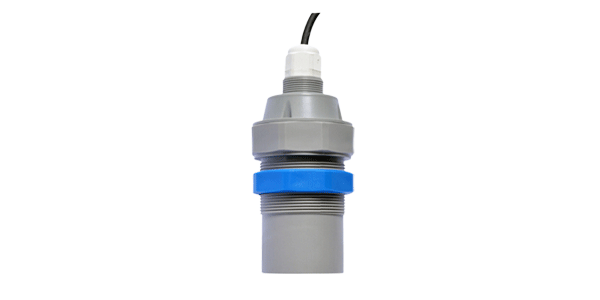
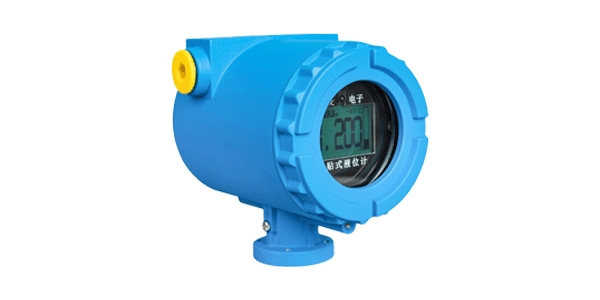
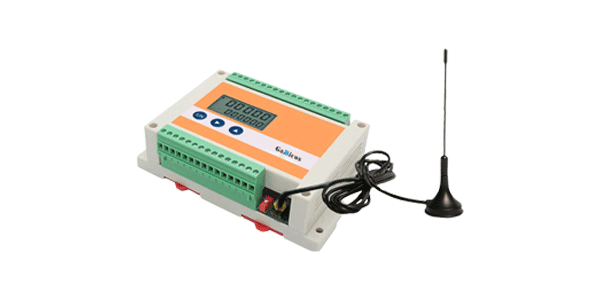
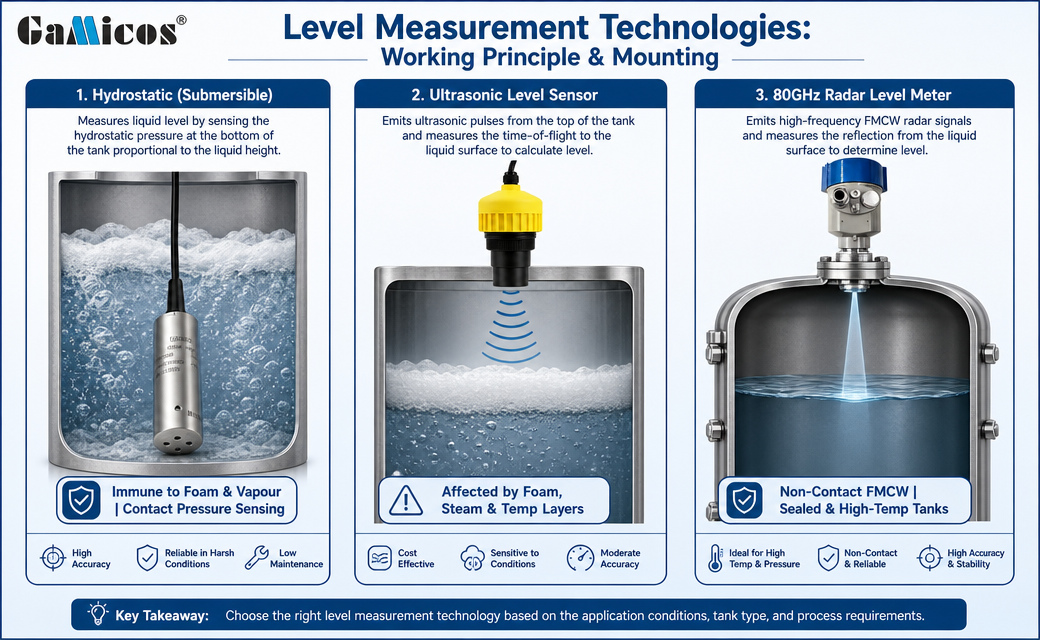
Image 1 — the three mounting arrangements side by side
How Each Technology Works
The three technologies differ in one fundamental way: what they actually measure. Hydrostatic sensing measures the weight of the liquid column. Ultrasonic and radar measure the distance to the surface. Everything else — accuracy, failure modes, cost — follows from that difference.
Hydrostatic / submersible
Pressure at the bottom of the tank, converted to level. In contact with the medium.
Blind spot: density changes.
Ultrasonic
Time of flight of a sound pulse bouncing off the surface. Non-contact.
Blind spot: foam, steam, temperature layers.
Radar (FMCW)
Time of flight of a 76–81 GHz electromagnetic sweep. Non-contact.
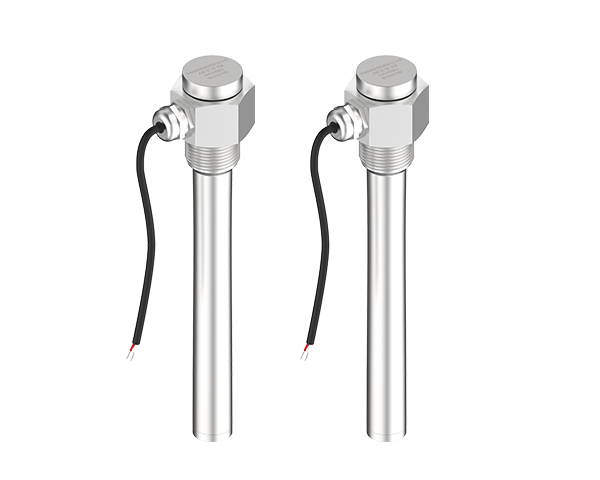
A hydrostatic level sensor works on a principle that has not changed in a century: a column of liquid exerts pressure proportional to its height. The sensor is lowered into the medium, where it measures the static head pressure and converts it into a level reading.
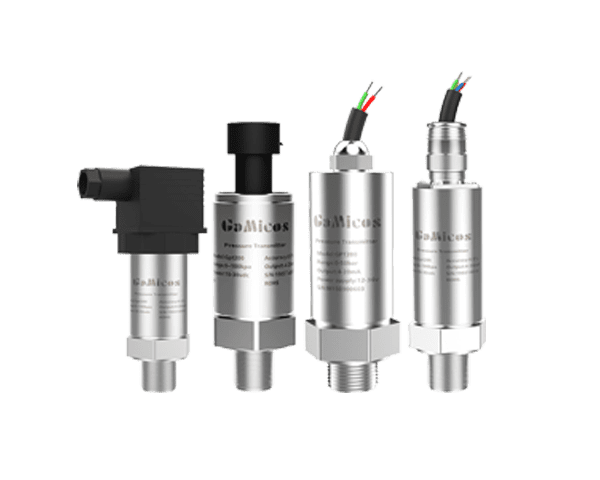
Because the sensing element sits in direct contact with the liquid, this method is largely immune to surface turbulence, foam, and vapour — the three conditions that blind every non-contact technology. A typical pressure type level sensor such as the GAMICOS GLT500 uses 316L stainless steel wetted parts for harsh media while holding accuracy to ±0.5% FS or ±0.25% FS.
Ultrasonic level measurement
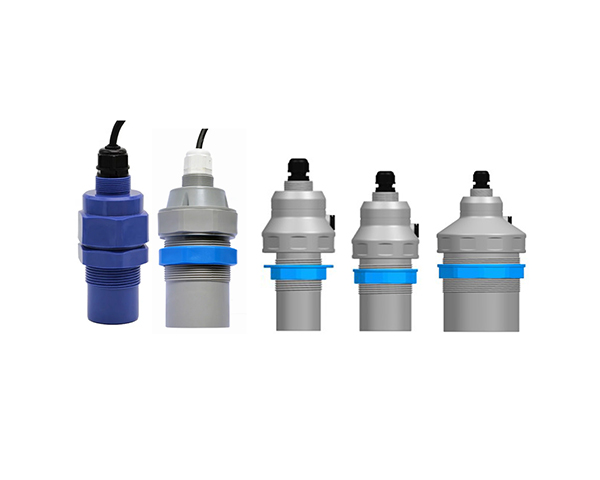
Ultrasonic sensors emit high-frequency sound waves toward the liquid surface and calculate level from the time of flight of the returning echo.
The physics that make them cheap also make them fragile. Sound travels at roughly 343 m/s in air, and that speed changes with temperature. Temperature gradients above a warm liquid bend the beam; heavy foam absorbs it; steam scatters it; strong air currents on an outdoor tank displace it. Each of those conditions produces a measurement error that has nothing to do with the sensor’s quality.
Radar level measurement
Radar level meters use electromagnetic waves — typically FMCW, where the transmitter sweeps a frequency band and compares the returned signal against the sweep — to measure distance to the surface. Electromagnetic waves do not care about air temperature, pressure, or vapour, which is why radar holds accuracy in conditions that defeat ultrasonic.
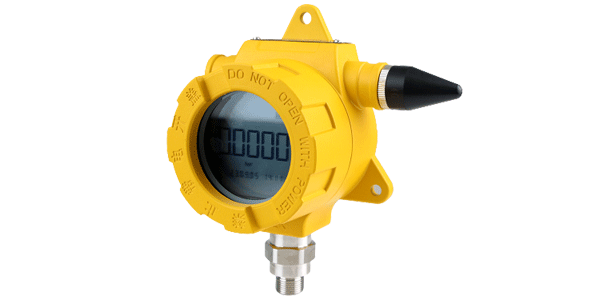
A modern 80 GHz radar level meter such as the GAMICOS GLT745 works at 76–81 GHz and delivers millimetre-level accuracy in complex industrial environments. The trade-offs are a clear line of sight requirement, weaker returns from low-dielectric liquids, and condensation on the antenna.
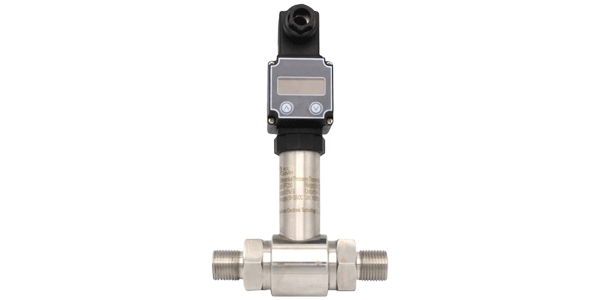
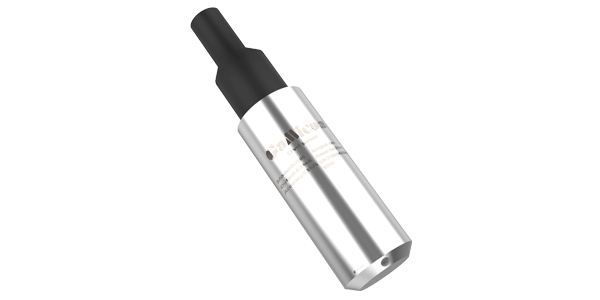
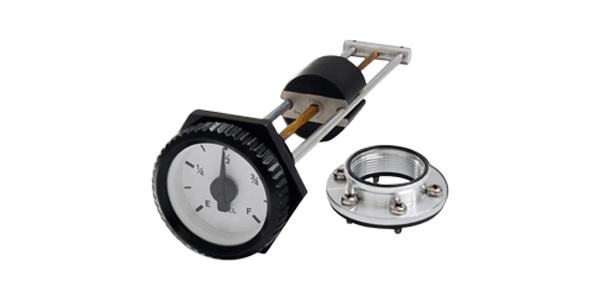
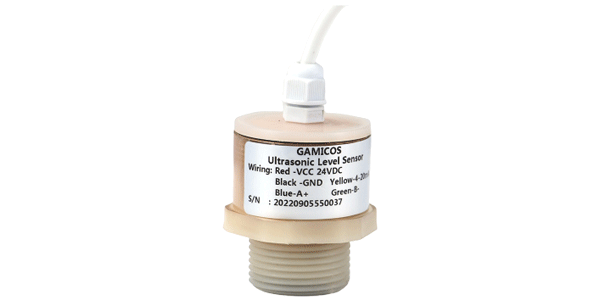
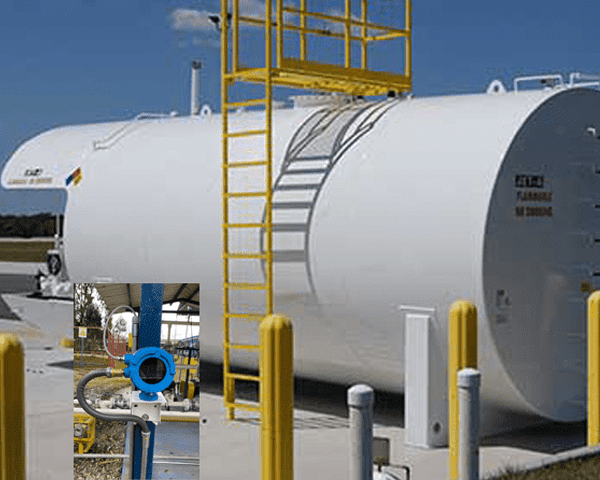
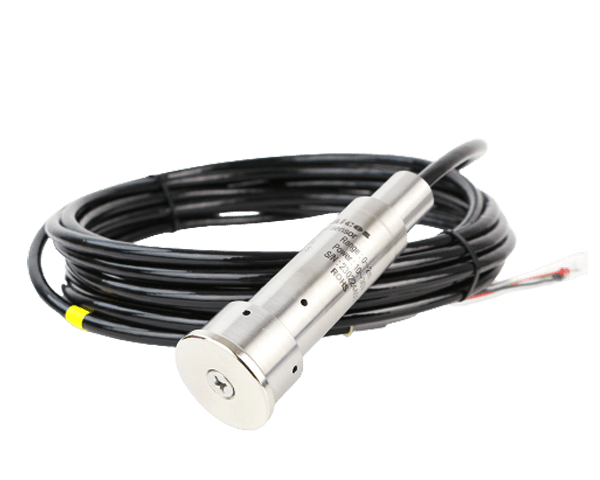
Image 2 — installation comparison — narrow well, open tank, closed tank with nozzle.
Head-to-Head Comparison
Here is how the three technologies line up on the specifications that decide most projects.
Hydrostatic, ultrasonic and radar level sensing compared.
Feature
Submersible Level Sensor
Ultrasonic Level Sensor
Radar Level Meter
Measurement type
Contact (hydrostatic)
Non-contact (sound waves)
Non-contact (EM waves)
Installation
Submerged in liquid
Top-mounted, open tank
Top-mounted, open or closed tank
Accuracy
High (±0.25% FS typical)
Moderate (±3–10 mm)
Very high (±1 mm)
Environmental impact
Immune to vapour and foam
Affected by temperature, foam, steam
Immune to temperature and vapour
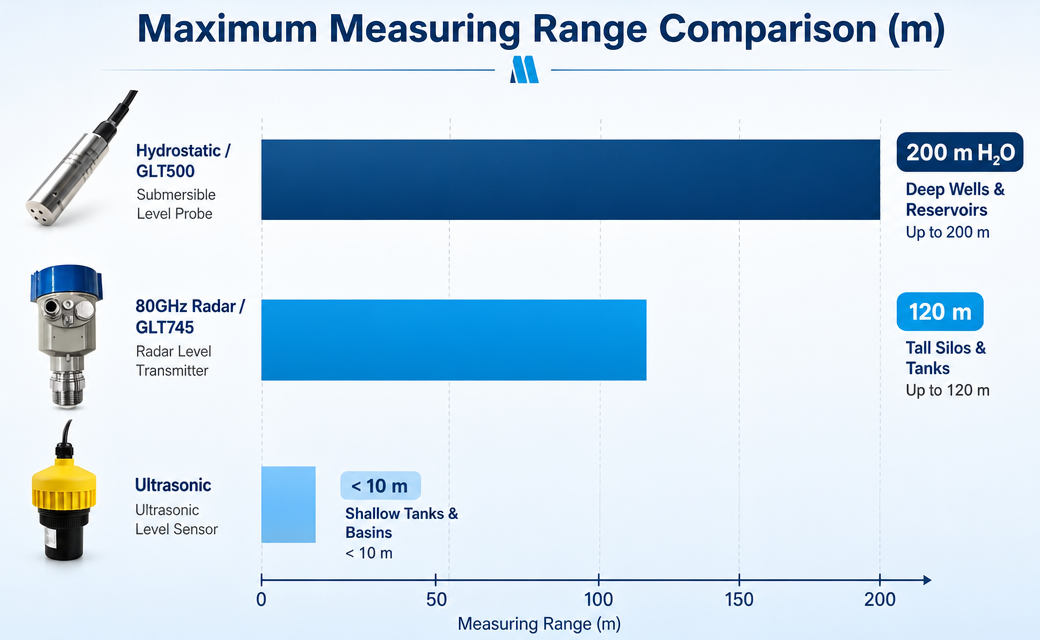
Max range
Up to 200 m H2O
Typically under 10 m
Up to 120 m
Maintenance
Low (periodic cleaning)
Moderate (transducer check)
Low (antenna cleaning)
Cost
Low to moderate
Moderate
High
Read the accuracy column carefully. The three ratings are not expressed in the same unit. Submersible sensors are specified as a percentage of full scale, ultrasonic and radar in millimetres. On a 10 m range, ±0.25% FS equals ±25 mm — wider than radar’s ±1 mm but far narrower than ultrasonic’s ±3–10 mm. Compare absolute error at your actual range, never the bare number.
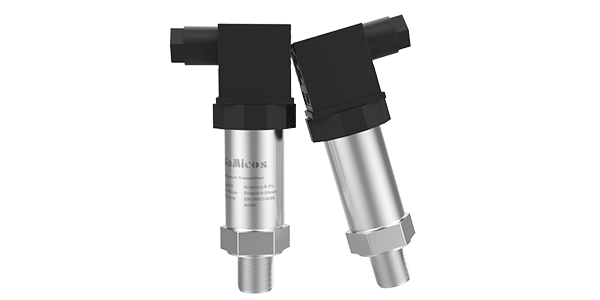
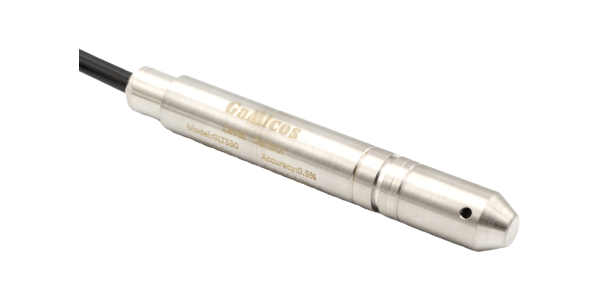
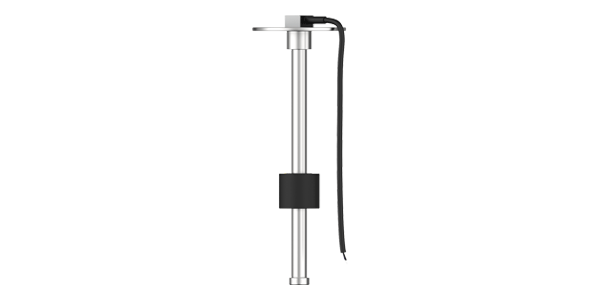
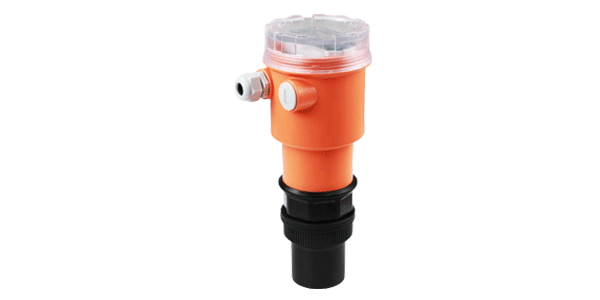
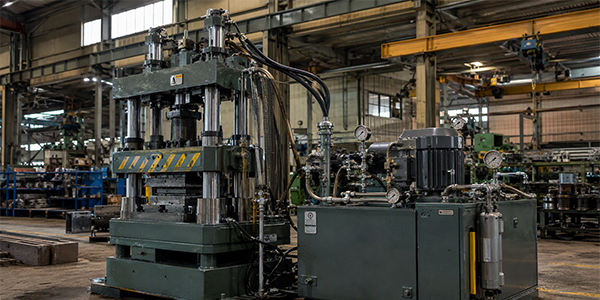
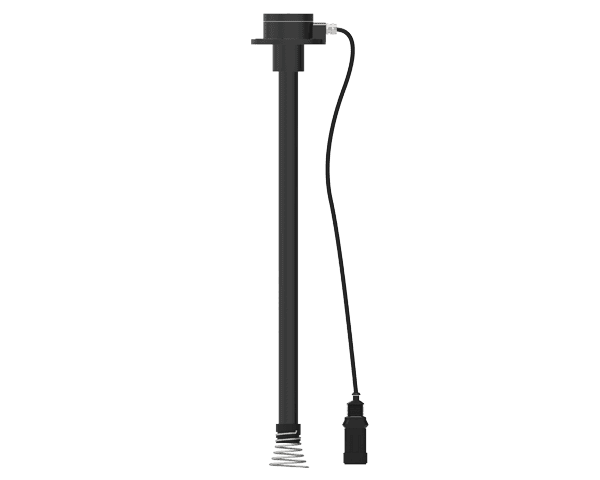
Image 3 — range comparison chart
When a Submersible Sensor Is the Only Choice
Despite the rise of non-contact technologies, there are five situations where a submersible level sensor is not one option among several — it is the only one that will work.
1. Deep wells and boreholes
In a deep well, the diameter is narrow and the depth is extreme. A non-contact sensor mounted at the top has to shoot a beam down a shaft a few centimetres wide, past casing joints, couplings, and condensation, and get a clean echo back from a surface tens of metres away. In practice, that does not happen reliably.
A submersible sensor is simply lowered to the required depth and reads pressure at that point. Well casing irregularities, condensation, and the narrow geometry stop mattering, because nothing is being aimed.
2. High-vapour and foam environments
Tanks holding hot liquids, chemicals with heavy off-gassing, or processes that generate thick foam will blind an ultrasonic sensor outright and confuse a radar echo. Foam is the classic case: a layer of stable foam absorbs sound almost completely and scatters radar energy, so the instrument reports a level that corresponds to the top of the foam rather than the liquid beneath it.
A hydrostatic sensor ignores every surface condition, because it measures pressure at the bottom of the tank. If the liquid level changes, the pressure changes — foam, vapour, and turbulence have no vote.
One honest caveat: hydrostatic measurement assumes a known liquid density. A change in density — from temperature, concentration, or a different product — shifts the reading. Where density varies significantly, either compensate for it or reconsider radar.
3. Open reservoirs and river monitoring
Environmental monitoring in rivers, lakes, and reservoirs is a long-duration game. Instruments are installed and expected to log for years with minimal attention, in flowing water, wind, rain, and debris.
A submersible sensor delivers stability here that non-contact units struggle to match: nothing sits above the water to be disturbed by wind, and nothing depends on a clear acoustic or optical path. Devices built for these applications — again, the GLT500 is the reference example — carry IP68 protection and run continuously in flowing water unaffected by surface debris.
4. Slurry and high-solids applications
Wastewater sludge, mining tailings, and mud defeat non-contact sensors in two ways: the signal attenuates in the dense medium, and material builds up on the transducer or antenna until the instrument is effectively blind.
A submersible sensor with a flush-mounted diaphragm handles high-solids liquids without clogging. The diaphragm is large, flat, and wiped clean by the medium itself as level moves — a self-cleaning geometry that a recessed acoustic horn cannot offer.
5. Cost-sensitive high-accuracy requirements
For applications needing high accuracy over moderate ranges — up to 200 m — a submersible sensor usually offers the best performance-to-cost ratio. Radar delivers finer precision but at a materially higher price point, and ultrasonic may not reach the accuracy required for custody transfer or precise process control.
In practice this is the most common decision path in water and wastewater: 0.5% FS hydrostatic accuracy covers the control loop, and the money saved on radar goes into more measurement points.
When Radar Is the Better Choice
Radar wins wherever contact with the medium is hazardous, contaminating, or physically impossible. A radar level meter is the right answer for:
Pressurised or vacuum tanks. Radar measures through a sealed tank nozzle without interrupting the process — a submersible sensor cannot be installed in a closed vessel at all.
Corrosive or sanitary applications. Where liquid contact must be avoided to prevent contamination or sensor degradation, non-contact is not a preference, it is a requirement.
Long-range storage tanks. Bulk storage of oil, chemicals, or grain beyond roughly 30 m is radar territory.
High-temperature processes. Radar antennas tolerate temperatures that would destroy submersible electronics and cable insulation.
The GLT745, with its 76–81 GHz FMCW technology and ±1 mm accuracy, represents the current state of the art in this category for petrochemical, power, and metallurgy applications.
When Ultrasonic Makes Sense
Ultrasonic sensors remain the pragmatic choice for general-purpose, cost-effective level measurement in benign conditions:
Open tanks with clean water. Municipal water tanks, irrigation reservoirs, and sump pits — no foam, no steam, no temperature stratification.
Short-range applications. Where the measuring range is under 5 m and high precision is not critical.
Budget-conscious projects. When process conditions are stable and a radar investment cannot be justified.
The pattern is consistent: ultrasonic is excellent until the environment stops being boring. The moment foam, steam, or a draught appears, the reading stops being trustworthy.
Quick Decision Guide
Match your application to the table below. Where two rows apply, the more demanding condition wins.
Application to technology mapping.
If your application has…
Recommended technology
Deep wells, foam, vapour, slurry
Submersible level sensor
Pressurised tanks, over 30 m range, corrosive media
Radar level meter
Clean water, short range, low budget
Ultrasonic level sensor
Environmental monitoring (rivers, reservoirs)
Submersible level sensor
High temperature, sanitary or hazardous media
Radar level meter
High accuracy at moderate cost
Submersible level sensor
Product Spotlight: GAMICOS Solutions for Every Scenario
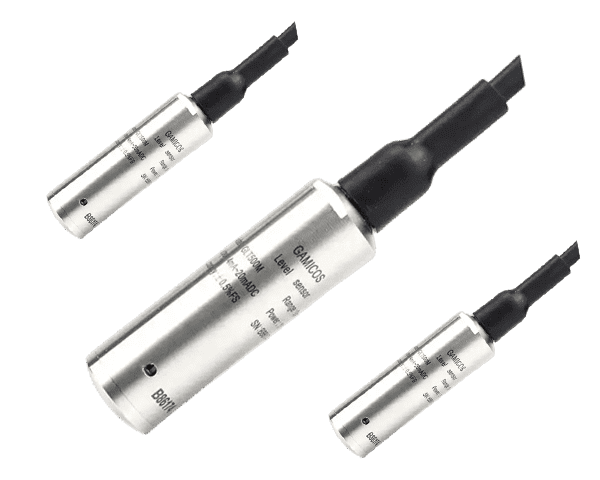
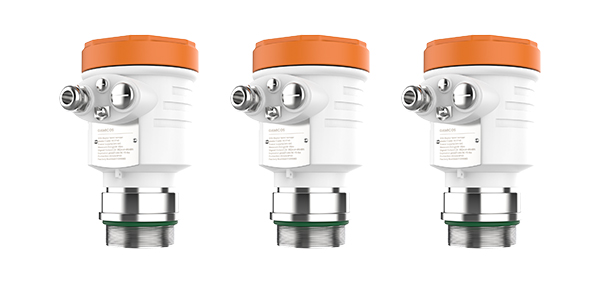
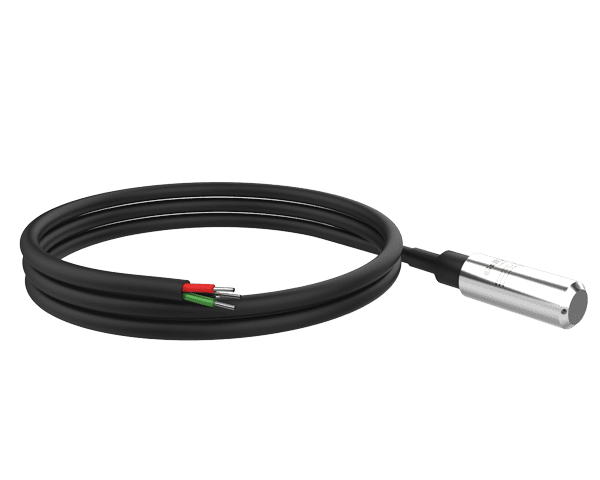
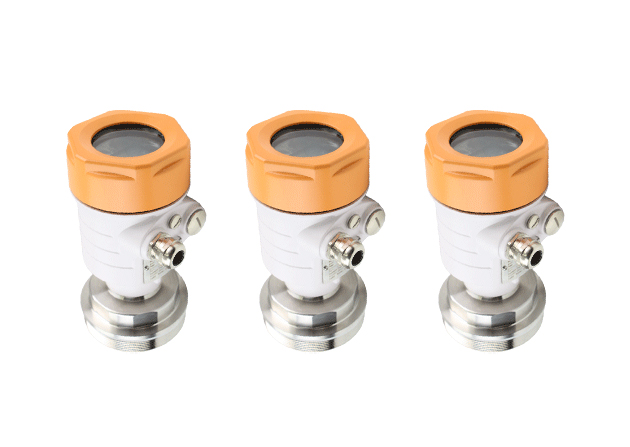
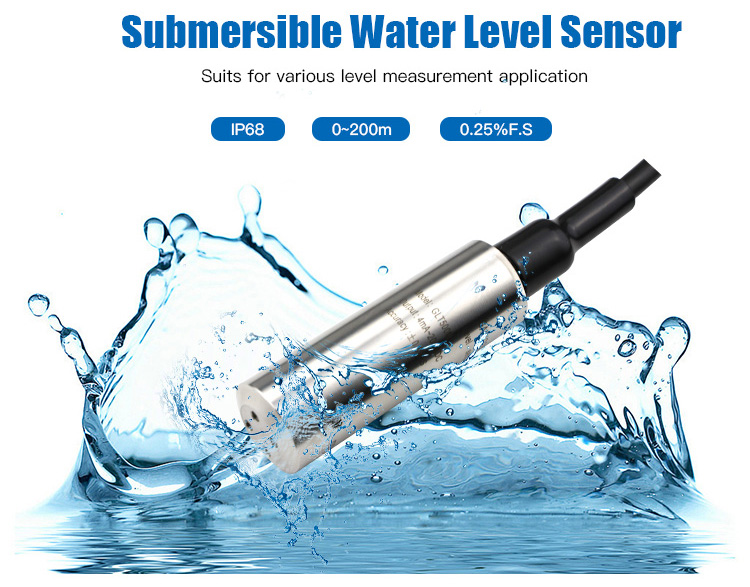
GLT500 submersible level sensor
The GLT500 is a premium submersible level sensor engineered for reliability in the most demanding environments — the deep well, the foaming sump, the river gauge that nobody wants to visit twice.
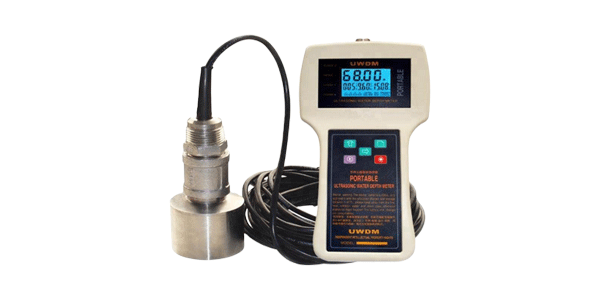
GLT500 submersible level sensor — official product image.
Housing: Φ27 × 103 mm (2088 enclosure), 304 SS or 316L SS options
Customisation: full OEM support, including cable length and pressure range
Ideal for wastewater treatment, river and lake monitoring, deep wells, slurry measurement, reservoirs, irrigation, and water diversion projects.
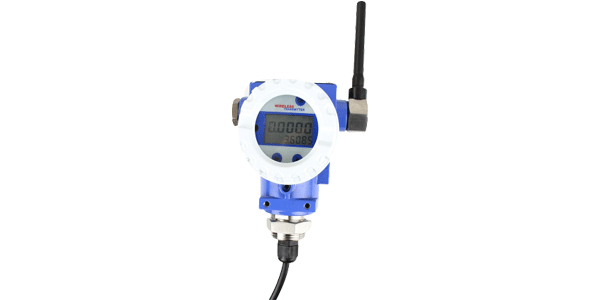
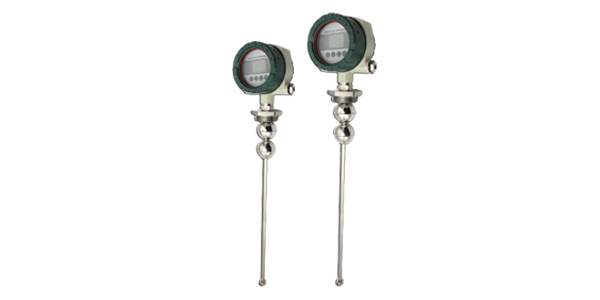
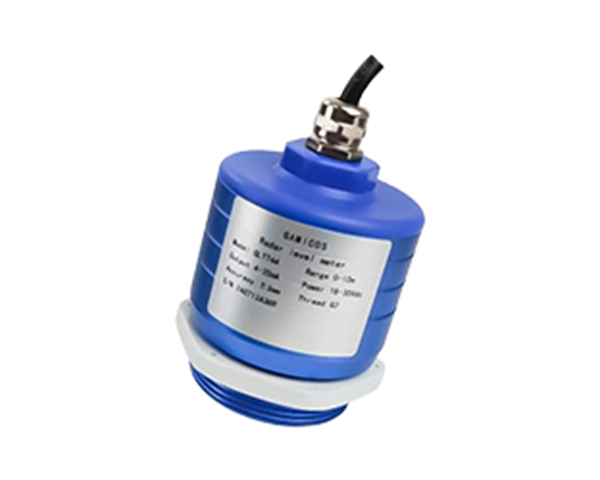
GLT745 radar level meter
For the cases on the other side of the decision — sealed tanks, aggressive media, long range, high temperature — the GLT745 covers non-contact measurement with industrial-grade precision.
Frequency: 76–81 GHz FMCW
Accuracy: ±1 mm
Measurement range: up to 120 m
Output: 4~20 mA, RS485 / Modbus
Protection: IP68
Measurement type: non-contact
Applications: petrochemical, power, metallurgy, chemical storage tanks and silos
Frequently Asked Questions
What is the maximum depth a submersible level sensor can measure?
A high-quality submersible level sensor such as the GLT500 measures up to 200 mH2O, which makes it suitable for deep wells and boreholes where non-contact technologies cannot reach. Practical depth is usually set by cable length and the pressure range ordered, not by the sensing principle itself.
Can a submersible level sensor work in corrosive liquids?
Yes. Sensors with 316L stainless steel wetted parts and specialised coatings handle most corrosive media. For highly aggressive chemicals — strong acids, chlorinated brine, some solvents — confirm material compatibility with the manufacturer before ordering, because the diaphragm and seal materials, not the electronics, set the limit.
How often does a submersible level sensor need maintenance?
A well-designed submersible level sensor needs very little. Periodic inspection and cleaning of the sensing diaphragm — typically once a year — is sufficient for most applications. In high-solids or scaling media, shorten that interval based on what the diaphragm looks like at the first inspection.
Is a radar level meter better than a submersible sensor?
Not necessarily — they solve different problems. Radar excels in pressurised tanks and long-range applications, but a submersible level sensor is superior in deep wells, foamy conditions, and cost-sensitive high-accuracy scenarios. The right choice depends on the tank, the medium, and the budget, not on which technology is newer.
What output signals are available for submersible level sensors?
Most submersible level sensors offer multiple output options, including 4~20 mA, 0~5 V, 1~5 V, 0~10 V, 0.5~4.5 V, and RS485 digital communication, allowing direct integration with PLCs, data loggers, and SCADA systems. Choose the output that matches your existing controller rather than adding a converter later.
Not sure which technology your tank needs?
Tell us the medium, the range, and what is happening at the surface — foam, steam, pressure, or nothing at all — and our engineers will recommend the configuration that will still be reading correctly in five years.